

Puzzles, Mysteries, and Muddles
Naming and Taming the Problems
Keep You Up at Night
Program Description
In any industry, success is a direct result of an organization’s ability to solve problems. In this workshop, we take a deep look at the components of effective problem-solving. You will learn exactly how to make your problem-solving efforts more precise, efficient, and effective.
Most of us have learned how to solve problems using analysis that produces a “correct” or “best” solution. However, not all problems are alike, and different types of problems require different approaches to finding solutions. Armed with an understanding of those differences, you will be able to gain a more nuanced view of a problem situation and see how to target your approach.
Einstein is quoted as saying that if he had an hour to save the world, he would spend fifty-five minutes defining the problem and five finding the solution. Puzzles, Mysteries, and Muddles™ is based on 20 years of research by Jerry Talley, Ph.D., and will provide you with sophisticated insights and approaches that will enhance your success as a problem- solver.

Puzzles, Mysteries, and Muddes is available virtually. For more info, see our page on Virtual Learning Journeys.
For more information on Puzzles, Mysteries, and Muddles™, click here.
Puzzles, Mysteries, and Muddles™ is a copyrighted program of Barnes & Conti Associates, Inc.
Program Objectives
As a participant, you will be able to:
- Define four distinch phases of problem-solving.
- Apply key criteria to differentiate among six different problem types.
- Apply the problem types to your specific situation
- Identify the problem type(s) that you are dealing with and the most appropriate path to resolution.
- Find high-quality solutions at the lowest possible cost in time, effort, and other resources.
- Produce a plan that is ready to execute in your organization.
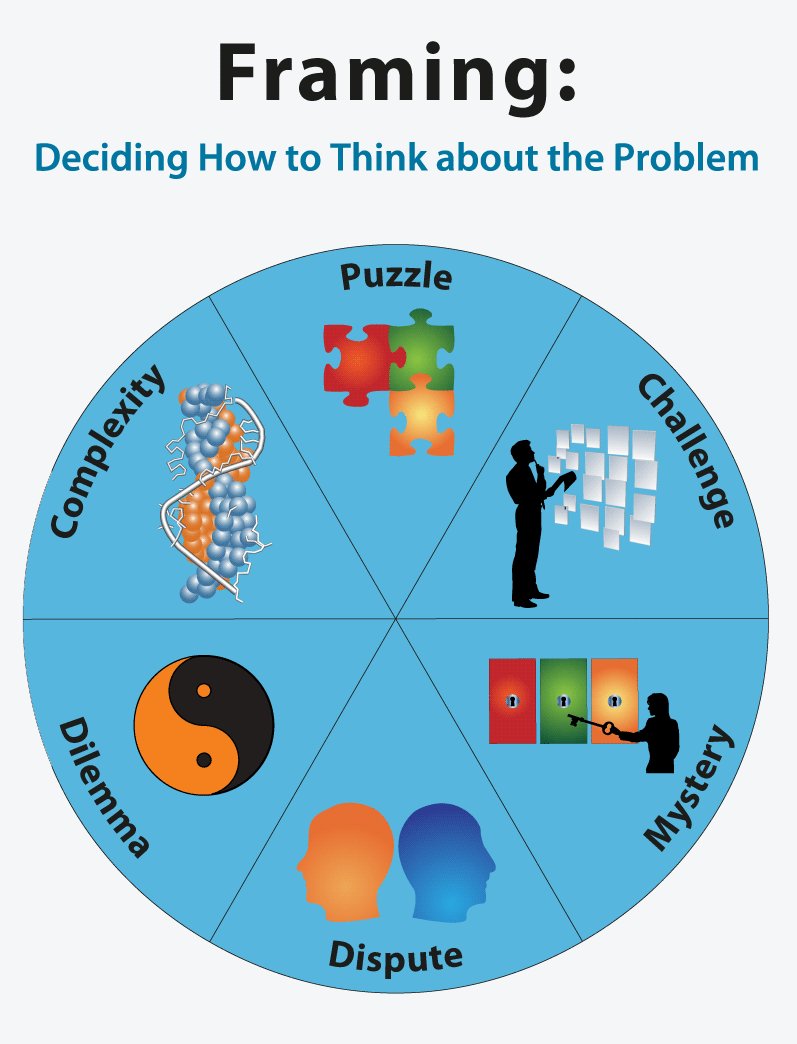
After naming the problem, framing the problem helps you solve it by giving it a type and tailoring your solution accordingly.
What our clients say:
Need more information? Call us at 510.644.0911 or send us an email.
Copyright 2014, 2021 Barnes & Conti Associates, Inc. All rights reserved.


About Barnes & ContiNewsPublic ProgramsEvents |
Programs & ServicesInfluence & Communication
Innovation &
Decision-Making & Problem Solving Leadership
Internal Consulting Change Management |
Resources
Apps for Mobile Devices |
Follow Us!ContactBarnes & Conti Blog
|